Architecture Diagrams
Hub-Spoke Topology
Section titled “Hub-Spoke Topology”All scenarios share the same hub-spoke foundation. The hub contains shared services (DNS, optionally Firewall and VPN Gateway). The spoke hosts production workloads. Azure Bastion Developer is available as a portal capability for browser-based VM access — no dedicated Bastion resource is deployed.
Baseline
Section titled “Baseline”The simplest scenario — cloud-native with NAT Gateway for outbound internet. No hybrid connectivity, no centralized egress filtering.
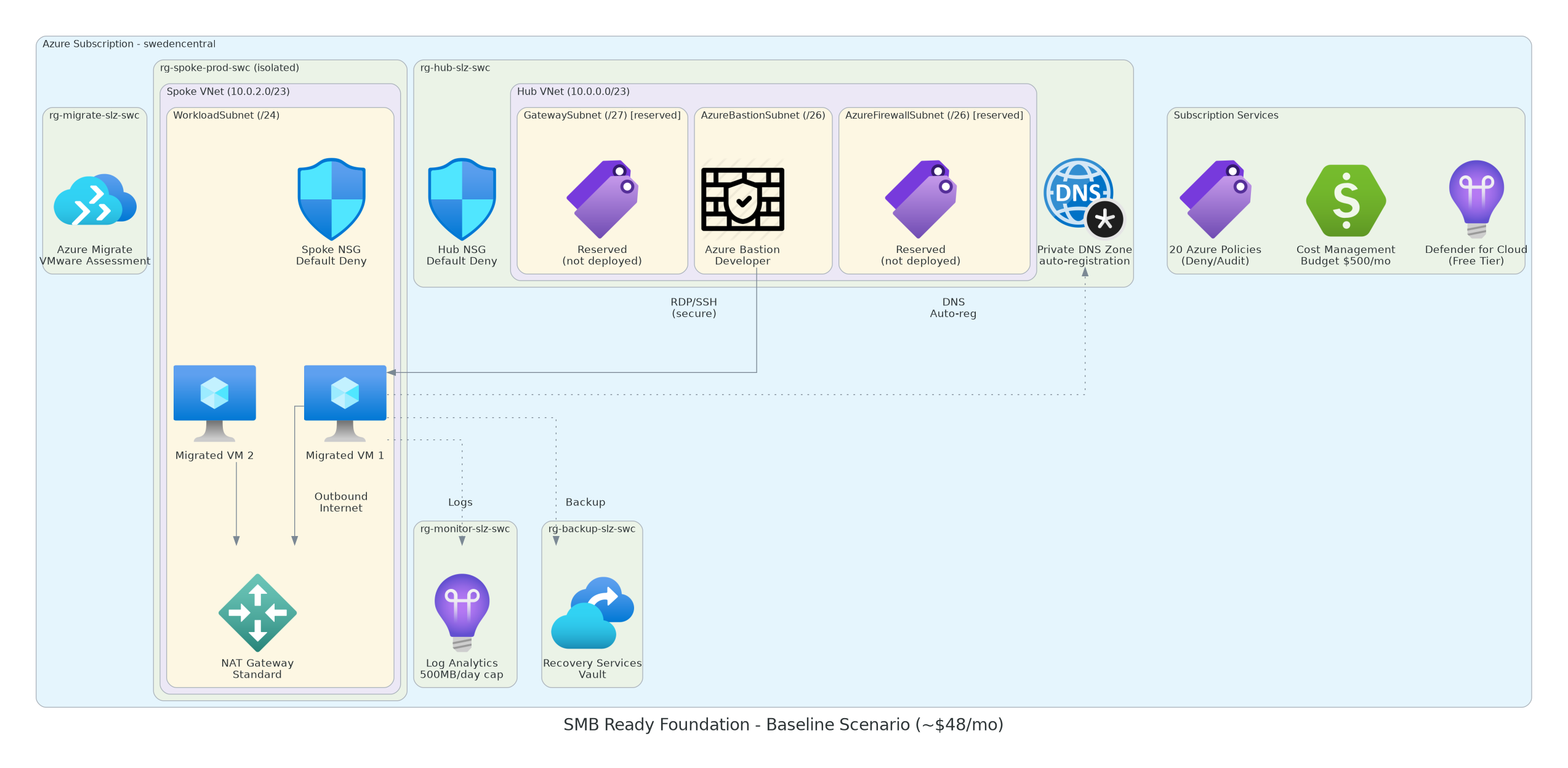
Resources: Hub VNet + NSG, Spoke VNet + NSG + NAT Gateway + PIP, Private DNS Zone, Key Vault + PE, Log Analytics, Automation Account, Recovery Vault, Migrate Project.
No peering — hub and spoke are independent VNets.
graph TB
  subgraph "Management Group: smb-rf"
    direction TB
    P["Azure Policies"]
  end

  subgraph "Subscription"
    direction TB
    subgraph "rg-hub-smb-swc"
      HubVNet["Hub VNet\n10.0.0.0/23"]
      HubNSG["NSG"]
      DNS["Private DNS Zone"]
    end
    subgraph "rg-spoke-prod-swc"
      SpokeVNet["Spoke VNet\n10.0.2.0/23"]
      SpokeNSG["NSG"]
      NAT["NAT Gateway + PIP"]
    end
    subgraph "rg-security-smb-swc"
      KV["Key Vault + PE"]
    end
    subgraph "rg-monitor-smb-swc"
      LA["Log Analytics"]
      AA["Automation Account"]
    end
    subgraph "rg-backup-smb-swc"
      RSV["Recovery Services Vault"]
    end
    subgraph "rg-migrate-smb-swc"
      MIG["Azure Migrate"]
    end
  end

  SpokeVNet --> NAT
  KV -.->|"Private Endpoint"| SpokeVNet
  P -->|"Inherited"| HubVNet
  P -->|"Inherited"| SpokeVNet
Firewall
Section titled “Firewall”Adds Azure Firewall for centralized egress control. All spoke traffic is routed through the firewall via UDR. NAT Gateway is removed (Firewall handles outbound).
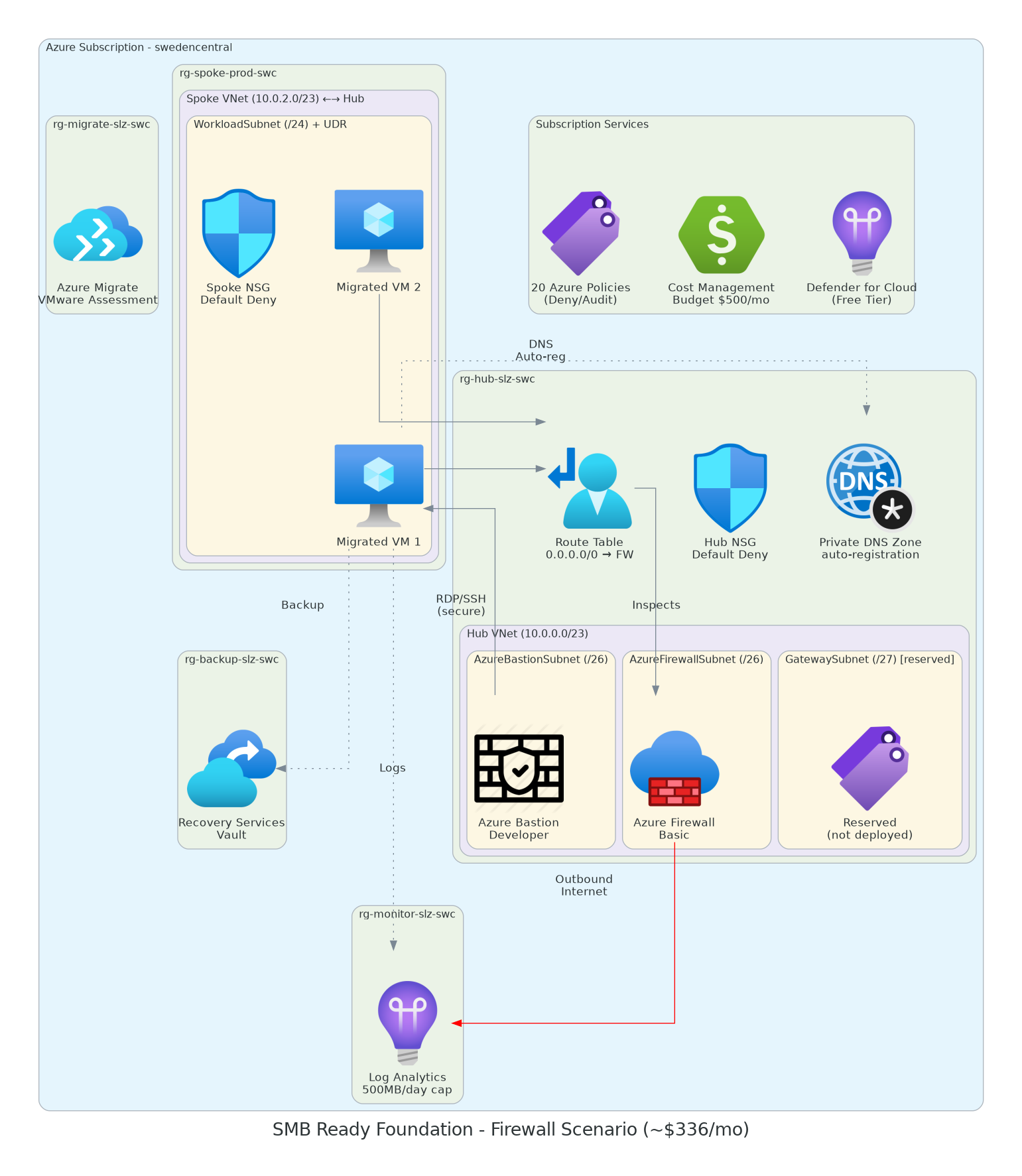
Additional resources: Azure Firewall + Firewall Policy + 2 PIPs, Route Tables (spoke + gateway), Hub↔Spoke peering.
Adds VPN Gateway for site-to-site connectivity to on-premises. Uses gateway transit through hub↔spoke peering. NAT Gateway provides outbound internet (no firewall).
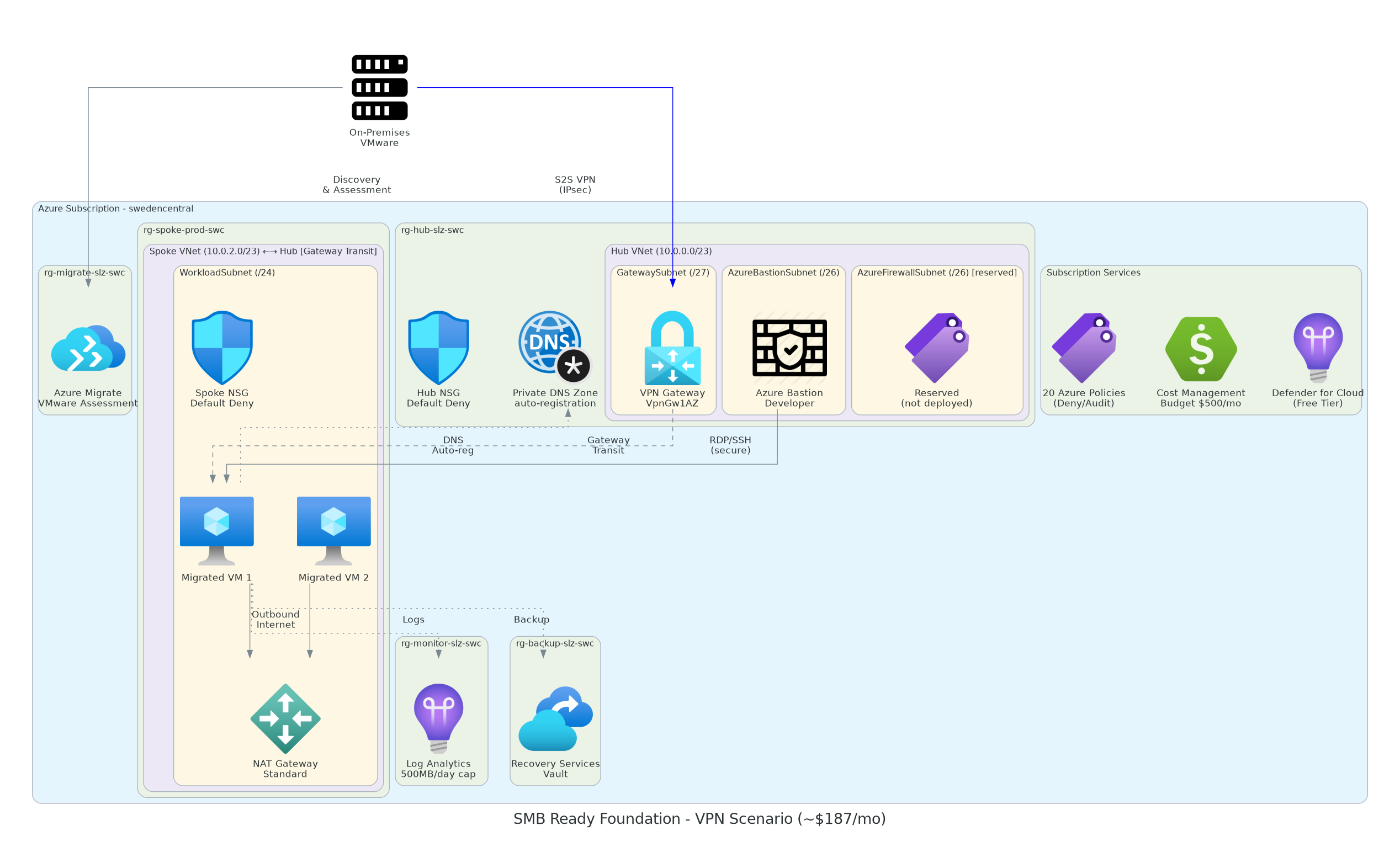
Additional resources: VPN Gateway + PIP, Hub↔Spoke peering with gateway transit.
Requires: ON_PREMISES_ADDRESS_SPACE parameter.
Combines Firewall and VPN Gateway. Maximum protection with centralized egress and hybrid connectivity. All spoke and on-premises traffic routes through the firewall.
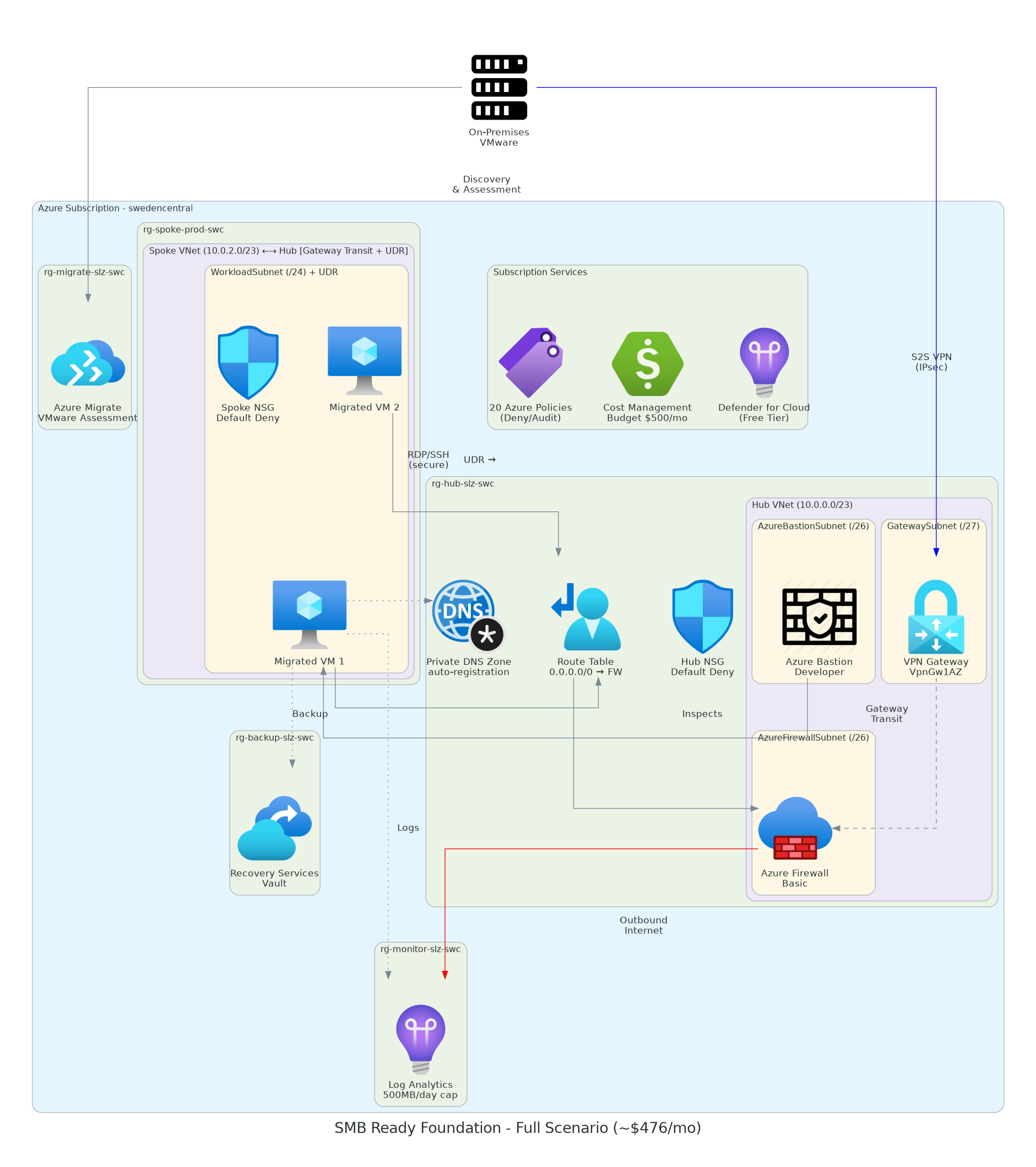
Additional resources: Azure Firewall + policy + PIPs, VPN Gateway + PIP, Route Tables, Hub↔Spoke peering with gateway transit.
Resource Group Layout
Section titled “Resource Group Layout”All scenarios use the same 6 resource groups:
| Resource Group | Contents | Scope |
|---|---|---|
rg-hub-smb-{region} | Hub VNet, NSG, DNS, Firewall*, VPN GW*, Route Tables* | Shared |
rg-spoke-prod-{region} | Spoke VNet, NSG, NAT GW* | Workload |
rg-monitor-smb-{region} | Log Analytics, Automation Account | Operations |
rg-backup-smb-{region} | Recovery Services Vault | Backup |
rg-security-smb-{region} | Key Vault + Private Endpoint | Security |
rg-migrate-smb-{region} | Azure Migrate Project | Migration |
*Conditional — depends on scenario.