
Demo: Il-Pastizzeria ta' Mario
Follow a real Azure workload from brief to validated delivery
Il-Pastizzeria ta' Mario uses the full APEX workflow: requirements, architecture, governance, planning, code generation, deployment, and as-built documentation — built live in a 30-minute demo session.
This walkthrough is designed for existing users who want to understand what the system produces, how each step connects, and where the human review moments sit.
The artifact bodies below remain generated output. The refreshed demo chrome only improves orientation, readability, and navigation.
A Maltese catering outlet needs an online ordering app on Azure
The owner of a small catering outlet in Malta wants to sell pastizzi, Cisk, and Kinnie online. Payment is strictly cash on delivery. The app is a containerized React SPA backed by Azure Table Storage — simple enough for a demo, real enough to exercise the full pipeline.
- Shows the full agent handoff chain instead of a single isolated artifact.
- Preserves the real generated output, including review and validation traces.
- Demonstrates how policy discovery and adversarial review affect the result.
- Lets readers jump directly to the step that answers their current question.
Pick a step or read the journey in order
Each card explains what the step produces and why it matters so you can skim the journey before opening a dense artifact.
Requirements
The opening artifact captures what the catering outlet needs: an online ordering app for pastizzi, Cisk, and Kinnie with GDPR compliance and a EUR 100-500 monthly budget.
- Business context
- Functional requirements
- Compliance & security
- Budget & scaling
Solution Architecture
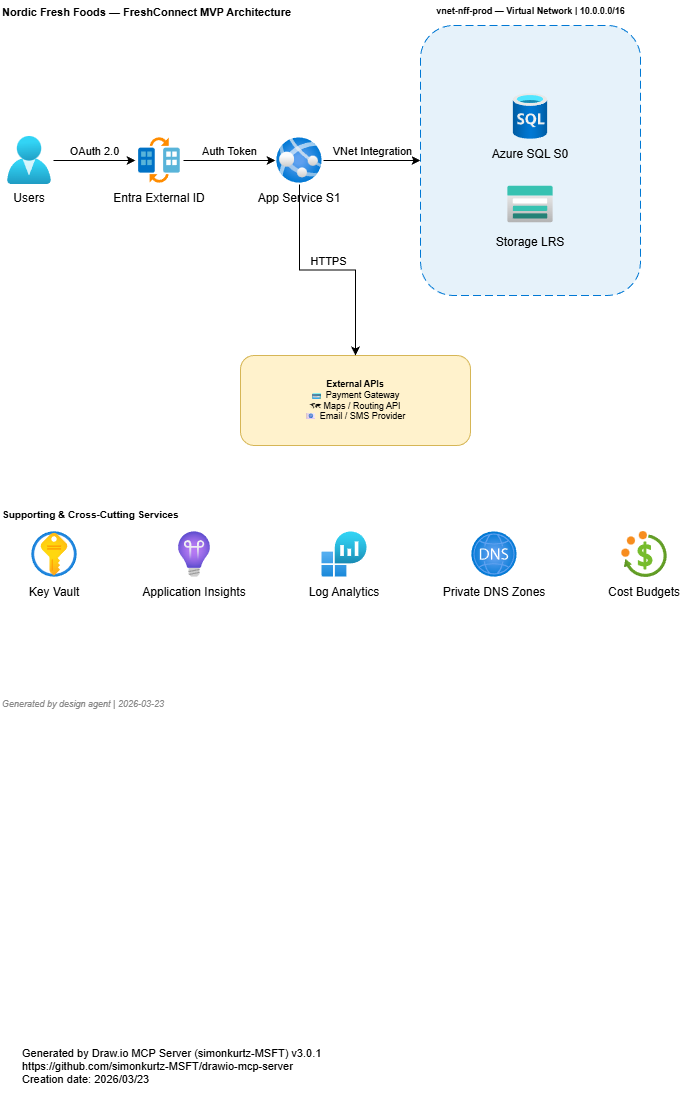
App Service S1 with VNet integration and private endpoints. WAF scores: Security 8, Reliability 7, Performance 9, Cost 7, Operations 7. Estimated ~$155/month.
- Service topology
- WAF assessment
- SKU recommendations
Design Artifacts
Three ADRs (App Service S1, Table Storage, public network posture), architecture diagram, and cost breakdown with distribution and projection charts.
- Architecture diagram
- Architecture decisions
- Cost estimates
Governance
Live REST API discovery found 21 policy assignments including a 9-tag deny blocker on resource groups. Storage and Key Vault hardening are audit-only.
- Policy effects
- Required tags
- Deployment blockers
Infra-as-Code Plan
12 resources across 10 AVM Bicep modules deployed in 5 phases. Governance-adapted tag contract expands from 4 to 9 required tags.
- Module structure
- Implementation tasks
- Dependency flow
Infra-as-Code Gen
AVM-first Bicep output with 10 modules. Bicep build, lint, and security baseline all pass. Preflight check confirms AVM versions.
- File structure
- Validation results
- AVM modules
Deployment
Deployed via azd provision in 5 minutes. S1 was unavailable in swedencentral — auto-switched to P0v3. All 12 resources provisioned successfully.
- Preflight checks
- Deployment phases
- Outputs
As-Built Docs
Post-deployment documentation: design document, resource inventory, operations runbook, backup/DR plan, compliance matrix, and cost estimate.
- Design
- Resources
- Operations
- Compliance
- Cost
Adversarial Reviews
Four independent adversarial reviews found 1 critical (ACR SKU mismatch), 2 high, 10 medium, and 13 low findings across all workflow steps.
- Requirements
- Architecture
- Governance
- Implementation
The walkthrough is polished, but the artifacts are still real
The refreshed demo intentionally separates editorial framing from generated content. You get a clearer product experience without losing auditability.
Navigation, layout, scanability, and mobile behavior. The walkthrough now guides readers through the sequence instead of leaving them inside raw markdown snapshots.
The artifact bodies, the validation trail, and the adversarial review evidence. The chrome is editorial; the underlying outputs remain the same generated material.