
WAF Assessment
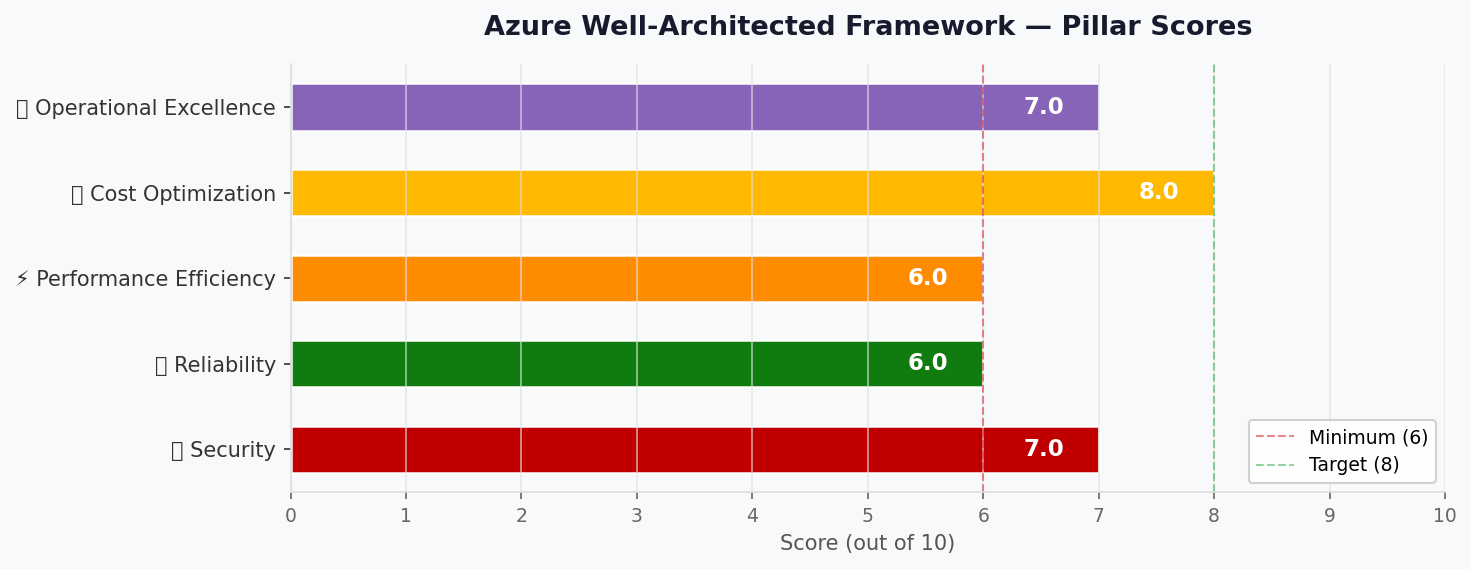
Overall WAF Scores
Section titled “Overall WAF Scores”| Pillar | Score | Confidence | Summary |
|---|---|---|---|
| 🔒 Security | 8/10 | High | MI + KV + TLS 1.2; VNet + private endpoints |
| 🔄 Reliability | 7/10 | High | 99.95% platform SLA; always-on, no cold start |
| ⚡ Performance | 9/10 | High | 1 TPS is trivial; always-on eliminates cold start |
| 💰 Cost Optimization | 7/10 | High | ~$126/mo; within budget, higher than consumption |
| 🔧 Operational Excellence | 7/10 | High | Staging slot, built-in logging; no CI/CD yet |
Primary Pillar Optimized: Security
Trade-offs Accepted: Higher cost (~$126/mo vs ~$25/mo) for VNet + private endpoints. No WAF, no multi-region. Data loss explicitly accepted for demo (ARC-001). GDPR erasure pattern defined (ARC-003). Staff access via Entra ID (ARC-005).
Security Assessment (8/10)
Section titled “Security Assessment (8/10)”Strengths:
- Managed Identity for App Service → Key Vault and Storage (no keys in code)
- Key Vault Standard with RBAC authorization for secrets management
- TLS 1.2+ enforced on App Service (managed certificates)
- VNet integration with dedicated /24 address space (10.0.0.0/24)
- Private endpoints for Key Vault, Storage, and ACR — no public data plane exposure
- Platform-managed encryption at rest for Storage and Key Vault
- No PCI scope — payment is strictly cash on delivery
- App Service built-in auth supports social IdP (Google, Microsoft) via Easy Auth
Gaps:
- ⚠️ No WAF/DDoS protection — low traffic does not justify cost
- ⚠️ Social IdP data processing may cross EU boundaries (noted in REQ-002)
- ⚠️ Staff authentication requires a dedicated trust boundary (ARC-005 — see below)
GDPR Data Erasure Pattern (ARC-003)
Section titled “GDPR Data Erasure Pattern (ARC-003)”Table Storage entities must separate PII from order facts to support right-to-erasure:
| Partition | Row Key | Contains PII | Erasure Action |
|---|---|---|---|
customer_{id} | profile | Yes | Delete entire entity |
order_{date} | {orderId} | No (anonymized) | Retain (customer_id → hash) |
On erasure request: delete customer_* entities, replace customer_id with
a one-way hash in order entities. Orders are retained for business records
with no reversible PII.
Staff Access Trust Boundary (ARC-005)
Section titled “Staff Access Trust Boundary (ARC-005)”Staff operations (view orders, update status) must use a separate authentication path with verified role claims:
- Staff authenticate via Microsoft Entra ID (work accounts) — separate from customer social login
- App Service built-in auth validates
rolesclaim in the JWT - API enforces role-based access at the route level (
/api/staff/*requiresStaffrole) - Customer routes (
/api/orders) require only a valid social IdP token
This creates two trust boundaries: customers (social IdP, low privilege) and staff (Entra ID, elevated privilege).
Recommendations:
- Use App Service built-in authentication for social login (zero-cost)
- ✅ Private endpoints implemented for Key Vault, Storage, and ACR
- Document that social IdP identity tokens are processed by the IdP outside EU; only application data stays in swedencentral
- ARC-004 resolved: VNet + private endpoints replace public endpoints
Reliability Assessment (7/10)
Section titled “Reliability Assessment (7/10)”Strengths:
- App Service S1 SLA: 99.95% (exceeds 99.0% target)
- Always-on eliminates cold start — consistent response times
- Staging slot enables blue-green deployments with zero-downtime swaps
- Storage Account LRS: 11 nines durability within swedencentral
- ACR Premium stores images durably with geo-redundant metadata
- Built-in health probes and auto-restart on App Service
- Single region is acceptable for dev/demo with relaxed RTO (24h)
Gaps:
- ❌ No automated backup for Table Storage (REQ-001/ARC-001) — explicitly accepted for demo (see below)
- ⚠️ No failover region configured
ARC-001 Resolution — Table Storage Backup
Section titled “ARC-001 Resolution — Table Storage Backup”Decision: For this dev/demo environment, data loss is explicitly accepted. The 12h RPO requirement from Step 1 is relaxed to best-effort for the demo. Table Storage LRS provides 11 nines durability against hardware failure but does not protect against accidental deletion or application-level corruption.
Production path: Before promoting to production, add a scheduled Azure Function (timer trigger, daily) that exports all Table Storage entities to Blob Storage as JSON. Estimated additional cost: ~$1-2/month.
Recommendations:
- ✅ Demo: accept data loss risk (RPO relaxed to best-effort)
- ⚠️ Production: implement daily export job before go-live
- ✅ Always-on enabled — no cold start concerns
- For production: consider GRS storage or Cosmos DB for geo-redundancy
Performance Assessment (9/10)
Section titled “Performance Assessment (9/10)”Strengths:
- 1 TPS is negligible for App Service S1 (handles thousands of TPS)
- Always-on eliminates cold start — consistent sub-second response times
- Table Storage supports 20,000 entities/second per account — 1 TPS is trivial
- React SPA delivers fast client-side rendering after initial load
Gaps:
- ⚠️ No CDN for static assets (acceptable for demo with < 1K users)
Recommendations:
- 30-second polling interval for order status is acceptable for demo
- For production: add Azure CDN or Front Door for static asset caching
- ✅ Always-on eliminates cold start — no min-replicas tuning needed
Cost Assessment (7/10)
Section titled “Cost Assessment (7/10)”| Metric | Value |
|---|---|
| Monthly Estimate | ~$155/month |
| Annual Estimate | ~$1,858/year |
| Budget Status | ✅ Within budget (25-126% of EUR 100-500) |
| Confidence | High (App Service S1 pricing confirmed) |
Cost Optimization Applied:
- App Service S1 with always-on (~$73/mo — eliminates cold starts)
- ACR Premium (~$50/mo — supports private endpoints, 500 GiB storage)
- VNet + private endpoints (~$23/mo — secures data plane traffic)
- Standard LRS storage (cheapest durable option)
- Log Analytics free tier (< 5 GiB/month ingestion)
- Key Vault per-operation pricing (negligible at low TPS)
- Staging slot included in S1 tier (zero additional cost)
Full cost breakdown available in the Sizing & Pricing page.
Operational Excellence Assessment (7/10)
Section titled “Operational Excellence Assessment (7/10)”Strengths:
- App Service auto-configures Log Analytics integration
- Staging slot enables blue-green deployments with zero-downtime swaps
- Managed TLS certificates eliminate renewal burden
- Familiar App Service platform with extensive tooling support
- Bicep IaC ensures repeatable infrastructure
Gaps:
- ⚠️ No CI/CD pipeline defined (manual container pushes)
- ⚠️ No custom alerts or dashboards
- ⚠️ No runbook automation for incident response
- ⚠️ Best-effort support model (no SLA for operational response)
ARC-002 Resolution — Application Monitoring
Section titled “ARC-002 Resolution — Application Monitoring”Application Insights is added to the architecture (free tier, 5 GiB/month). This addresses the monitoring gap identified in the requirements:
- Application Insights provides request timing, dependency tracing, and application-level failure diagnostics (beyond platform logs)
- Auto-instrumentation via App Service
- Free tier (5 GiB/month) is sufficient for demo traffic
- Shares the same Log Analytics workspace as the backend
Recommendations:
- Define a GitHub Actions workflow for CI/CD in a later phase
- Add basic Azure Monitor alerts for 5xx errors and high latency
- Document a simple operational runbook for container restart procedures
- Configure Application Insights connection string via Key Vault