
European Digital Commitments
Overview
Section titled “Overview”On April 30, 2025, Microsoft announced five comprehensive commitments to support digital sovereignty and innovation across Europe. These commitments demonstrate Microsoft’s recognition that European organizations require enhanced control, transparency, and sovereignty over their digital infrastructure and data.
Official Announcement: Microsoft’s European Digital Commitments
The Five Commitments
Section titled “The Five Commitments”1. Expanded Cloud Regions Across Europe
Section titled “1. Expanded Cloud Regions Across Europe”Commitment: Increase the number of Azure cloud regions and datacenters throughout Europe to provide broader geographic coverage and enhanced data residency options.
Implementation:
- New datacenter regions launched in multiple European countries
- Expanded capacity in existing regions
- Enhanced availability zones for resilience
Customer Benefits:
- More choices for data residency
- Lower latency for European users
- Improved disaster recovery options within Europe
- Compliance with local data laws
Status (2025): Microsoft now operates Azure regions in multiple European countries including Germany, France, Switzerland, Sweden, Norway, Poland, and more.
2. EU Data Boundary for the Microsoft Cloud
Section titled “2. EU Data Boundary for the Microsoft Cloud”Commitment: Enable customers to store and process their data within the European Union, with limited and transparent exceptions.
EU Data Boundary
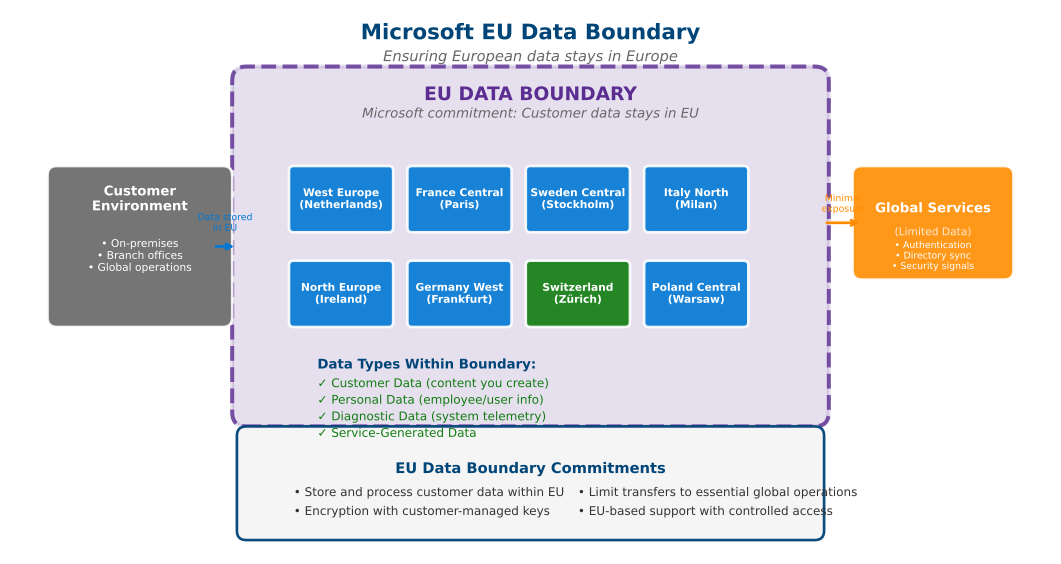 Figure: Microsoft EU Data Boundary showing data residency and processing within EU/EFTA countries
Geographic Scope:
The EU Data Boundary consists of 31 countries:
- 27 EU Member States: Austria, Belgium, Bulgaria, Croatia, Cyprus, Czechia, Denmark, Estonia, Finland, France, Germany, Greece, Hungary, Ireland, Italy, Latvia, Lithuania, Luxembourg, Malta, Netherlands, Poland, Portugal, Romania, Slovakia, Slovenia, Spain, Sweden
- 4 EFTA Countries: Liechtenstein, Iceland, Norway, Switzerland
Data Categories Covered:
| Data Type | Storage Location | Processing Location |
|---|---|---|
| Customer Data | EU/EFTA datacenters | EU/EFTA |
| Pseudonymized Personal Data | EU/EFTA datacenters | EU/EFTA |
| Professional Services Data | Stored at rest in EU/EFTA | EU/EFTA |
Key Features:
Data Residency:
- Customer data stored within the EU/EFTA
- Data processing occurs in EU/EFTA datacenters
- Backup and disaster recovery within EU/EFTA
Exceptions (Documented and Transparent):
- Some support scenarios (customer can control via Customer Lockbox)
- Certain metadata for service functionality
- Features requiring global routing (for example, Azure Front Door)
Customer Control:
- Customers can view data transfer scenarios
- Customer Lockbox for support access approval
- Audit logs for all data access
Services Covered:
- Azure (regional services in EU/EFTA regions)
- Microsoft 365
- Dynamics 365
- Power Platform
Datacenter Locations:
Microsoft operates or may use datacenters in: Austria, Belgium, Denmark, Finland, France, Germany, Greece, Ireland, Italy, Netherlands, Norway, Poland, Spain, Sweden, and Switzerland.
Reference: EU Data Boundary Countries and Datacenter Locations
3. Increased Capacity and Investment
Section titled “3. Increased Capacity and Investment”Commitment: Significant financial investment in European cloud infrastructure to meet growing demand and support digital transformation.
Investments Include:
Infrastructure:
- Datacenter construction and expansion
- Network connectivity enhancements
- Renewable energy projects
- Edge computing facilities
Economic Impact:
- Billions in capital investment
- Thousands of jobs created (construction, operations, support)
- Support for European technology ecosystem
- Partnership with local suppliers
Sustainability:
- Carbon-negative by 2030 commitment
- 100% renewable energy for datacenters
- Water-positive datacenters
- Circular economy initiatives for hardware
4. Expanded Sovereign Cloud Controls
Section titled “4. Expanded Sovereign Cloud Controls”Commitment: Provide enhanced sovereignty features and controls within the Azure platform to meet strict European requirements.
Sovereign Capabilities:
Sovereign Landing Zone (SLZ):
- Enhanced governance and compliance controls
- Policy-driven architecture
- Identity and access management enhancements
- Audit and monitoring capabilities
Confidential Computing:
- Data encrypted in use, at rest, and in transit
- Hardware-based trusted execution environments
- Secure enclaves for sensitive workloads
- Attestation and verification
Key Management:
- Customer-managed encryption keys
- Bring Your Own Key (BYOK)
- Hold Your Own Key (HYOK) options
- Hardware Security Module (HSM) integration
Access Controls:
- Customer Lockbox for support access
- Just-in-time access mechanisms
- Privileged access management
- EU-based support personnel options
5. Digital Skilling and Training for Europe
Section titled “5. Digital Skilling and Training for Europe”Commitment: Invest in training and education to build digital skills across the European workforce.
Programs and Initiatives:
Skills for the Future:
- Free training programs for millions of Europeans
- Focus on in-demand cloud and AI skills
- Partnerships with educational institutions
- Industry certifications and credentials
Target Audiences:
- Job seekers and career changers
- Students and recent graduates
- IT professionals seeking upskilling
- Business leaders and decision-makers
Training Formats:
- Microsoft Learn (free online platform)
- Virtual training days
- Instructor-led courses
- Hands-on labs and workshops
Focus Areas:
- Cloud computing (Azure)
- Data and AI
- Cybersecurity
- Digital transformation
Impact:
- Millions trained since program launch
- Improved employability and career advancement
- Support for European digital economy
- Reduced skills gap in technology sector
EU Data Boundary: Deep Dive
Section titled “EU Data Boundary: Deep Dive”The EU Data Boundary is one of the most significant commitments for organizations with strict sovereignty requirements.
What Is the EU Data Boundary?
Section titled “What Is the EU Data Boundary?”A commitment to store and process customer data within the European Union, with clear documentation of any exceptions.
Scope:
- Customer Data: All data customers provide to Microsoft cloud services
- Personal Data: Data subject to GDPR
- Service-Generated Data: Data created during service operation
How It Works
Section titled “How It Works”Data Storage:
- Primary storage in EU datacenters
- Backup and disaster recovery within EU
- No routine data transfers outside EU
Data Processing:
- Computation occurs in EU regions
- Service operations within EU
- Support scenarios controlled by customer
Exceptions (Transparent and Documented):
-
Customer-Initiated Transfers:
- Customer explicitly configures data to leave EU
- Example: Customer creates resource in non-EU region
-
Support Scenarios:
- Customer Lockbox provides control
- Support personnel access only with approval
- Time-limited and logged access
-
Specific Service Features:
- Global routing (Azure Front Door, Traffic Manager)
- Threat intelligence (security services)
- Service telemetry (can be disabled)
Documentation and Transparency:
- Published list of data flows
- Regular updates and communications
- Customer controls and options
- Audit logs and reporting
Benefits for Customers
Section titled “Benefits for Customers”Regulatory Compliance:
- Simplifies GDPR compliance
- Supports Schrems II requirements
- Addresses data localization laws
- Reduces legal complexity
Risk Reduction:
- Minimizes cross-border data transfers
- Reduces exposure to foreign laws (for example, CLOUD Act)
- Clear audit trail for compliance
- Transparent operations
Business Confidence:
- Predictable data handling
- Clear contractual commitments
- Microsoft’s reputation and scale
- Continuous improvement and investment
Progress and Timeline
Section titled “Progress and Timeline”- Q1: EU Data Boundary architecture defined
- Q2: First services available with EU boundary
- Q3-Q4: Expanded service coverage
- Q1-Q2: Sovereign Landing Zone GA (Generally Available)
- Q3: Additional datacenter regions launched
- Q4: Enhanced confidential computing capabilities
- Q1-Q4: Continued expansion of EU Data Boundary services
- Additional regions and capacity
- Enhanced sovereign controls
2025 (Current)
Section titled “2025 (Current)”- April 30: Five commitments announced
- Ongoing: Full EU Data Boundary for core services
- New sovereignty features and capabilities
- Continued investment and expansion
Industry and Government Recognition
Section titled “Industry and Government Recognition”German Federal Office for Information Security (BSI):
- Recognition of Microsoft’s sovereign capabilities
- C5 attestation for Azure
European Commission:
- Engagement on digital sovereignty initiatives
- Collaboration on GAIA-X and European cloud projects
Financial Services:
- Adoption by major European banks
- Support for financial services regulations
Public Sector:
- Government cloud offerings
- Support for national digital strategies
Comparison: Standard Azure vs. Sovereign Capabilities
Section titled “Comparison: Standard Azure vs. Sovereign Capabilities”| Feature | Standard Azure | With Sovereign Controls |
|---|---|---|
| Data Residency | Customer chooses region | EU Data Boundary enforced |
| Data Processing | May occur globally | Guaranteed within EU |
| Support Access | Standard support model | Customer Lockbox required |
| Key Management | Microsoft-managed option | Customer-managed mandatory |
| Compliance | Standard certifications | Enhanced attestations |
| Access Controls | Standard RBAC | Enhanced IAM with SLZ |
| Audit Logs | Standard logging | Enhanced audit trail |
| Personnel | Global support teams | EU-based support option |
How to Enable EU Data Boundary
Section titled “How to Enable EU Data Boundary”For New Customers
Section titled “For New Customers”- Select EU Regions: Choose Azure regions within the EU for resource deployment
- Configure Tenant: Set tenant location to EU country
- Enable Policies: Apply Sovereign Landing Zone policies
- Configure Services: Ensure services respect data boundary
For Existing Customers
Section titled “For Existing Customers”- Assessment: Review current data locations and flows
- Migration Planning: Plan migration to EU regions
- Policy Application: Implement governance controls
- Validation: Verify data boundary compliance
- Ongoing Monitoring: Continuous compliance checking
Best Practices
Section titled “Best Practices”- Use Azure Policy to enforce regional restrictions
- Enable Customer Lockbox for all subscriptions
- Implement customer-managed keys (CMK)
- Regular compliance audits and reviews
- Training for operations teams on sovereignty requirements
Sales & Pre-Sales Talking Points
Section titled “Sales & Pre-Sales Talking Points”Value Proposition
Section titled “Value Proposition”“Microsoft’s European Digital Commitments demonstrate our long-term investment in European digital sovereignty. The EU Data Boundary ensures your data remains in Europe, with transparent operations and enhanced controls that support your compliance and business requirements.”
Discovery Questions
Section titled “Discovery Questions”- Do you have requirements to keep data within the EU?
- Are you subject to Schrems II or other data transfer restrictions?
- What level of control do you need over support access?
- Do you require EU-based operations personnel?
- How important is transparency in cloud operations for your organization?
Competitive Differentiation
Section titled “Competitive Differentiation”vs. AWS:
- More comprehensive EU data boundary commitment
- Clearer documentation of exceptions
- Stronger sovereign capabilities (SLZ)
vs. Google Cloud:
- Earlier and broader implementation
- More extensive datacenter footprint in Europe
- Deeper integration with existing enterprise workloads
vs. European Cloud Providers:
- Global scale with local sovereignty
- Broader service portfolio
- Continuous innovation and investment
Additional Resources
Section titled “Additional Resources”Official Documentation
Section titled “Official Documentation”- EU Data Boundary - Complete technical documentation
- Data Residency - Azure data residency information
- Sovereign Landing Zone - SLZ architecture
Microsoft Learn
Section titled “Microsoft Learn”- Get started with Microsoft Cloud for Sovereignty - Training path
Blog Posts and Announcements
Section titled “Blog Posts and Announcements”- Microsoft Blog: EU Data Boundary - Policy and announcements
- Azure Blog - Technical updates
Next Steps
Section titled “Next Steps”- Learn about Regulatory Requirements →
- Explore Data Residency Concepts →
- Return to Digital Sovereignty Overview →
Last Updated: October 2025