
Financial Services
PCI-DSS and regulatory compliant architecture for financial services with cardholder data protection.
Overview
Section titled “Overview”Financial services organizations face stringent regulatory requirements including PCI-DSS for payment card data, SOX for financial reporting, and increasingly DORA (EU) for digital operational resilience. This architecture addresses these requirements while maintaining data sovereignty.
Learning Objectives
Section titled “Learning Objectives”After completing this section, you will be able to:
- ✅ Design PCI-DSS compliant Azure architectures
- ✅ Implement cardholder data environment (CDE) isolation
- ✅ Configure fraud detection with AI/ML
- ✅ Meet financial regulatory requirements
_
Financial Services Architecture
Section titled “Financial Services Architecture”_
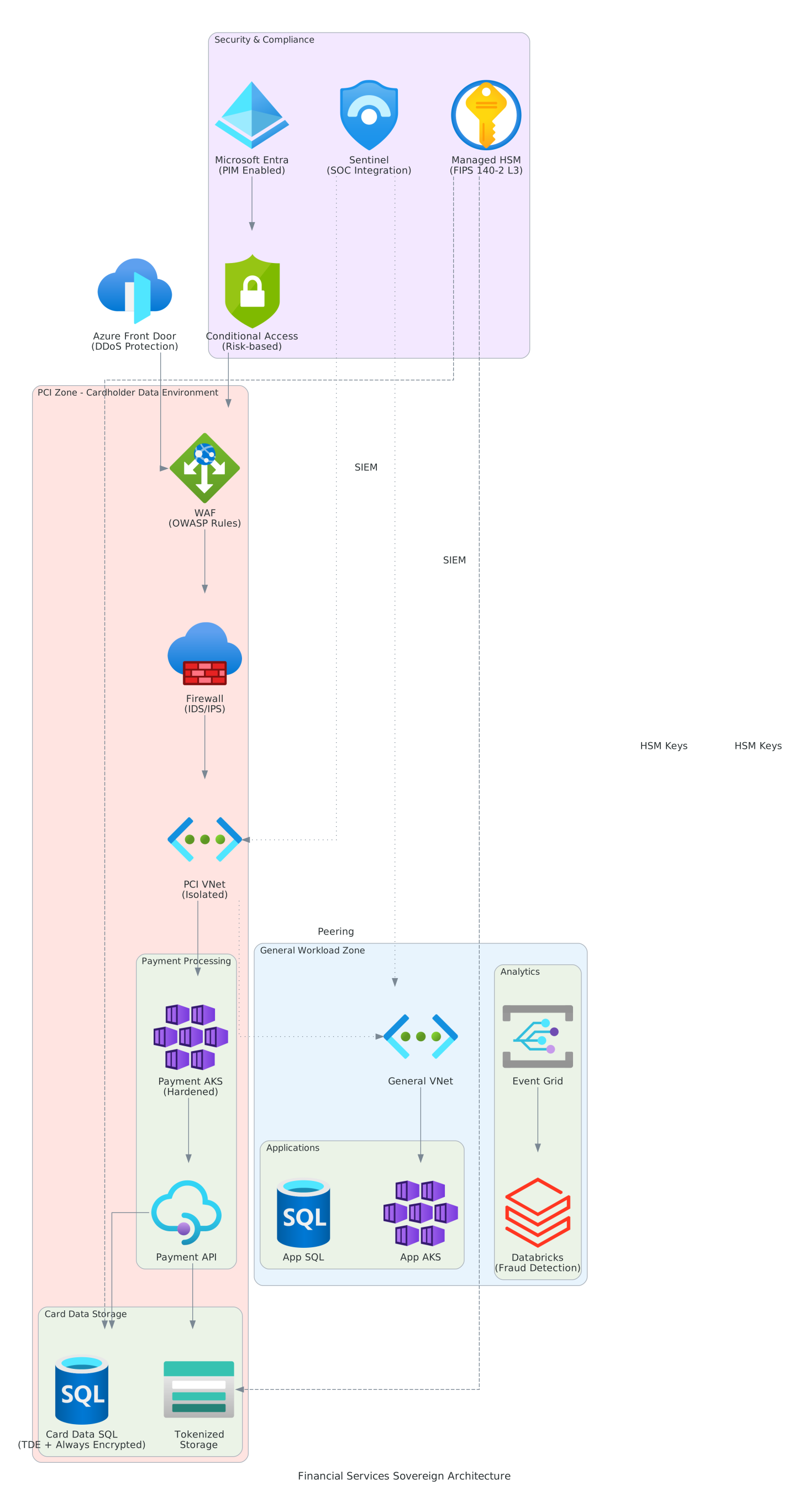 Figure 1: PCI-DSS compliant architecture with cardholder data environment isolation
Architecture Zones
Section titled “Architecture Zones”PCI Zone (Cardholder Data Environment)
The CDE is completely isolated from general workloads:
| Component | Purpose | PCI Requirement |
|---|---|---|
| Isolated VNet | Network segmentation | 1.3 |
| Azure Firewall with IDS/IPS | Traffic filtering | 1.4 |
| WAF with OWASP rules | Application protection | 6.6 |
| Payment AKS | Hardened containers | 2.2 |
| SQL with Always Encrypted | Column-level encryption | 3.4 |
| Tokenized Storage | PAN tokenization | 3.5 |
General Workload Zone
Section titled “General Workload Zone”Non-PCI workloads with controlled access to the CDE:
- Analytics workloads (fraud detection)
- Customer-facing applications
- Back-office systems
PCI-DSS Requirements Mapping
Section titled “PCI-DSS Requirements Mapping”Requirement 1: Network Security
Section titled “Requirement 1: Network Security”graph LR
A[Internet] -->|"❌ Blocked"| B[CDE VNet]
C[Internal Apps] -->|"Firewall<br/>Inspection"| B
B -->|"Private<br/>Endpoints"| D[Payment Services]
style B fill:#FFE4E1,stroke:#D13438
style D fill:#D4E9D7,stroke:#107C10
Requirement 3: Protect Stored Data
Section titled “Requirement 3: Protect Stored Data”| Data Type | Protection Method | Azure Service |
|---|---|---|
| Primary Account Number (PAN) | Tokenization | Custom tokenization service |
| CVV | Never stored | N/A |
| Cardholder Name | Encryption | Always Encrypted |
| Expiration Date | Encryption | TDE + CMK |
Requirement 7: Access Control
Section titled “Requirement 7: Access Control”# PIM configuration for CDE accessNew-AzureADMSPrivilegedAccessRole ` -RoleName "CDE-Administrator" ` -ResourceId "/subscriptions/{sub}/resourceGroups/pci-rg" ` -MaxDuration "PT4H" ` -RequireApproval $true ` -RequireJustification $true ` -RequireMFA $trueFraud Detection Architecture
Section titled “Fraud Detection Architecture”Real-time Transaction Scoring
Section titled “Real-time Transaction Scoring”# Event Hub -> Stream Analytics -> ML ScoringfraudDetectionPipeline: input: eventHub: name: "payment-transactions" consumerGroup: "fraud-detection"
processing: streamAnalytics: query: | SELECT TransactionId, Amount, Location, CardToken, UDF.ScoreFraudRisk(Transaction) as RiskScore FROM TransactionStream WHERE Amount > 1000 OR Location != LastKnownLocation
output: - highRiskQueue: "fraud-review" - dataLake: "transaction-archive"Machine Learning Model
Section titled “Machine Learning Model”The fraud detection model runs in a separate non-CDE zone:
- Input: Tokenized transaction metadata (no PAN)
- Processing: Azure Databricks with ML model
- Output: Risk score (0-100)
- Action: High-risk transactions flagged for review
HSM Key Management
Section titled “HSM Key Management”Managed HSM Configuration
Section titled “Managed HSM Configuration”# Create Managed HSM for payment processingNew-AzKeyVaultManagedHsm ` -Name "payment-hsm" ` -ResourceGroupName "pci-keys-rg" ` -Location "westeurope" ` -Sku "Standard_B1" ` -Administrator @("{security-team-object-id}")
# Create payment encryption keyAdd-AzKeyVaultKey ` -VaultName "payment-hsm" ` -Name "card-encryption-key" ` -KeyType "RSA-HSM" ` -Size 4096 ` -KeyOps @("encrypt", "decrypt", "wrapKey", "unwrapKey")Key Rotation Policy
Section titled “Key Rotation Policy”| Key Type | Rotation Frequency | Method |
|---|---|---|
| Data Encryption Key (DEK) | 90 days | Automatic |
| Key Encryption Key (KEK) | Annual | Manual with approval |
| TLS Certificates | 1 year | Automatic via Key Vault |
DORA Compliance (EU)
Section titled “DORA Compliance (EU)”For EU financial services, the Digital Operational Resilience Act (DORA) requires:
| Requirement | Implementation |
|---|---|
| ICT Risk Management | Microsoft Defender for Cloud |
| Incident Reporting | Sentinel with custom playbooks |
| Resilience Testing | Azure Chaos Studio |
| Third-party Risk | Vendor assessment via Purview |
| Information Sharing | Threat intelligence integration |
Implementation Checklist
Section titled “Implementation Checklist”- Complete PCI-DSS SAQ or ROC
- Deploy isolated CDE VNet
- Configure Azure Firewall with IDS/IPS
- Implement tokenization service
- Deploy Managed HSM
- Configure Always Encrypted for SQL
- Enable fraud detection pipeline
- Set up PIM for privileged access
- Configure file integrity monitoring
- Schedule quarterly vulnerability scans
Next Steps
Section titled “Next Steps”- Government Cloud Pattern → — FedRAMP implementation
- Critical Infrastructure → — OT/IT convergence
Reference: Azure PCI-DSS Blueprint — Microsoft Learn