
Edge RAG Implementation
Overview
Section titled “Overview”View Diagram: Edge RAG Implementation Architecture
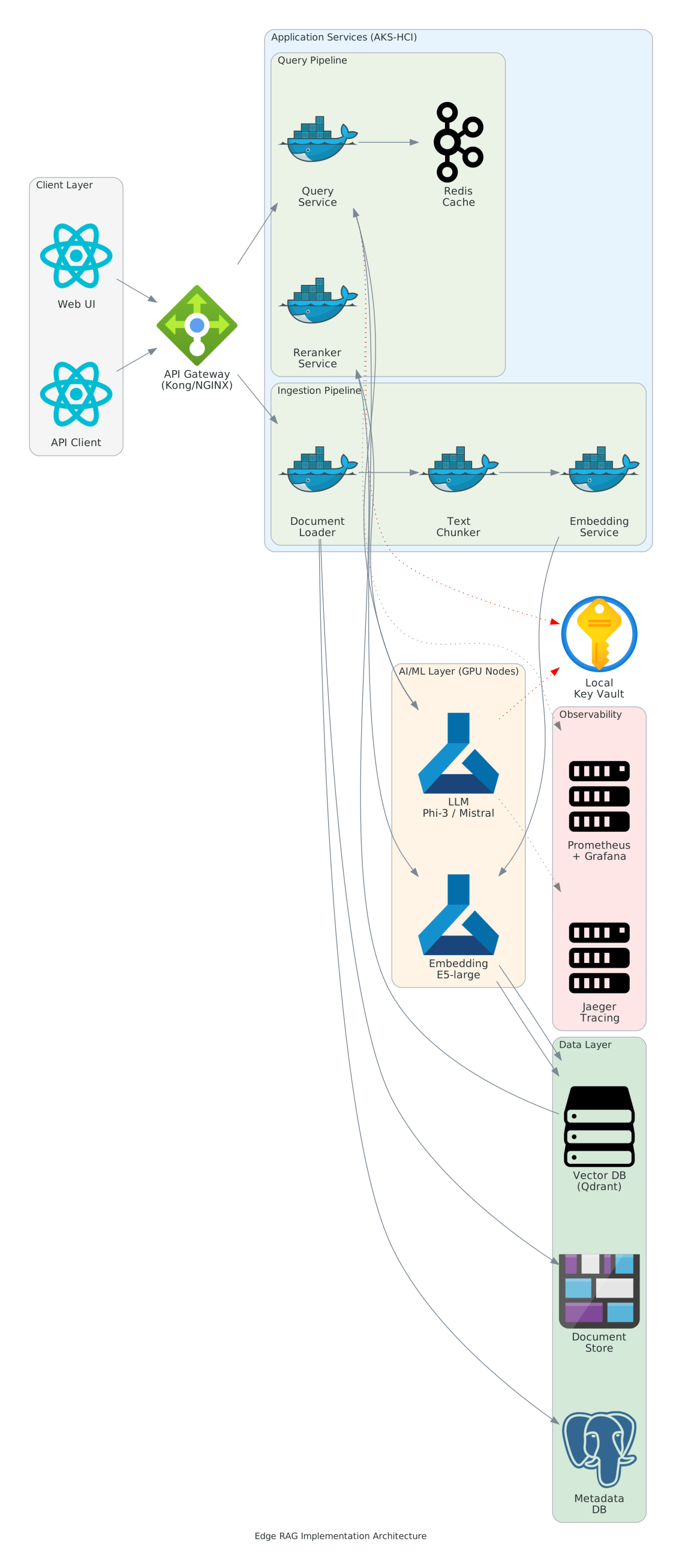 Figure 1: Production Edge RAG architecture on Azure Arc-enabled infrastructure
Edge RAG (Retrieval-Augmented Generation) Implementation transforms enterprise edge deployments into intelligent systems capable of processing and analyzing data locally while maintaining security and sovereignty. This module covers production-ready techniques for deploying RAG systems on Azure Arc at the edge, including LLM inference optimization, vector database tuning, and operational excellence patterns for enterprise environments.
Prerequisites
Section titled “Prerequisites”- Completion of Level 100: Edge RAG Concepts
- Understanding of Azure Arc and Kubernetes fundamentals
- Familiarity with LLM concepts and vector databases
- Basic DevOps and containerization knowledge
Learning Objectives
Section titled “Learning Objectives”By completing this module, you will:
- Design production RAG architectures for enterprise edge deployments
- Master LLM inference optimization techniques and strategies
- Understand vector database selection, tuning, and scaling
- Implement robust RAG deployment patterns and strategies
- Establish monitoring, operations, and observability for RAG systems
- Design for enterprise scale, resilience, and cost optimization
Edge RAG Architecture Foundation
Section titled “Edge RAG Architecture Foundation”Complete System Architecture
Section titled “Complete System Architecture”┌─────────────────────────────────────────────────────┐│ Application Layer (AI Experiences) ││ - Chat Interfaces, Search UIs, Analytics Apps │└─────────────────────┬───────────────────────────────┘ │┌─────────────────────▼───────────────────────────────┐│ Orchestration Layer (RAG Pipeline) ││ - Query Processing, Context Assembly, Response ││ - Vector Search, Embedding, Ranking │└─────────────────────┬───────────────────────────────┘ │ ┌─────────────────┼─────────────────┐ │ │ │┌───▼────────┐ ┌───▼───────┐ ┌────▼────────┐│ LLM Engine │ │ Vector │ │ Data ││ (Inference)│ │ Database │ │ Connectors ││ │ │ (Search) │ │ (Real-time)│└────────────┘ └───────────┘ └─────────────┘ │ │ │┌───▼────────────────────────────────────▼────────────┐│ Infrastructure Layer (Kubernetes/Arc) ││ - Container Runtime, Networking, Storage, Compute │└─────────────────────────────────────────────────────┘Core RAG Principles
Section titled “Core RAG Principles”-
Retrieval-First Design
- Queries retrieve relevant context from data stores
- Reduces hallucination through grounded responses
- Enables reasoning over proprietary data
-
Local Processing
- Keep data on-premises or in sovereign regions
- Reduce latency and bandwidth requirements
- Maintain data sovereignty and compliance
-
Production Readiness
- Horizontal scaling for throughput
- Vertical optimization for latency
- Fault tolerance and graceful degradation
-
Enterprise Integration
- Connect to existing data sources
- Maintain security and compliance policies
- Integrate with customer workflows
LLM Deployment Strategy
Section titled “LLM Deployment Strategy”Model Selection Framework
Section titled “Model Selection Framework”Factors for Edge Deployment
Section titled “Factors for Edge Deployment”-
Model Size & Performance
- Size: 7B-70B parameter models for edge (vs. 175B+ for cloud)
- Latency: Target <500ms for interactive applications
- Throughput: Support concurrent user requests
-
Hardware Constraints
- GPU Memory: 24GB-80GB typical for edge hardware
- Quantization: 4-bit or 8-bit reduces memory footprint 40-75%
- Inference Framework: VLLM, LLaMA.cpp, Ollama optimized for edge
-
Cost & Efficiency
- Licensing: Open-source models (Llama 2, Mistral) vs. proprietary
- Total Cost of Ownership: Hardware + maintenance vs. cloud APIs
- Performance per Watt: Critical for edge efficiency
Recommended Edge Models
Section titled “Recommended Edge Models”Model Family | Size | Parameters | Use Case | Edge-Ready |────────────────────────────────────────────────────────────────────────Llama 2 | 7B | 7B | General purpose | ✅ Optimal |Llama 2 | 13B | 13B | Complex reasoning | ✅ Optimal |Mistral | 7B | 7B | Multilingual/expert | ✅ Optimal |Phi-3 | 3.8B | 3.8B | Resource-constrained | ✅ Best |Phi-3 | 14B | 14B | High performance | ✅ Optimal |Neural Chat | 13B | 13B | Conversational | ✅ Optimal |CodeLlama | 7B | 7B | Code generation | ✅ Optimal |Mistral Medium | 24B | 24B | Enterprise reasoning | ✅ Good |LLM Inference Optimization
Section titled “LLM Inference Optimization”Quantization Strategy
Section titled “Quantization Strategy”Impact on Performance:
| Approach | Model Size | GPU Memory | Latency | Quality Loss |
|---|---|---|---|---|
| FP32 (Full) | 100% | 100% | Baseline | None |
| FP16 (Half) | 50% | 50% | -5% | <1% |
| 8-bit Quant | 25% | 25% | +10% | 2-3% |
| 4-bit Quant | 12.5% | 12.5% | +15% | 5-8% |
Recommended Configuration:
- Production: 4-bit quantization (best latency-quality tradeoff)
- High-accuracy: 8-bit quantization
- Real-time: FP16 (requires more VRAM)
Prompt Optimization
Section titled “Prompt Optimization”Structured prompts reduce inference time and improve quality:
System Prompt Structure:1. Role Definition (20-30 tokens)2. Task Instructions (30-50 tokens)3. Context Constraints (20-30 tokens)4. Output Format (10-20 tokens)
Total overhead: ~80-130 tokens (~240ms at typical speed)
Benefits:- Reduces hallucination- Improves response consistency- Enables deterministic formatting- Reduces total output tokens
Batch Processing for Throughput
Section titled “Batch Processing for Throughput”Single Request Flow:
- Parse query: 10ms
- Vector search: 50ms
- LLM inference: 500ms
- Format response: 10ms
- Total: 570ms
Batch Processing (10 requests):
- Consolidate requests: 10ms
- Vector search (batched): 80ms
- LLM inference (batched): 800ms (vs. 5000ms sequential)
- Format responses: 10ms
- Total: 900ms → 90ms per request
- Improvement: 6.3x throughput increase
Vector Database Architecture
Section titled “Vector Database Architecture”Database Selection Criteria
Section titled “Database Selection Criteria”-
Performance Metrics
- Query latency: <50ms for 1M vectors
- Throughput: 1,000+ QPS
- Recall accuracy: >95% for top-k search
-
Scalability
- Support millions of vectors
- Horizontal sharding capability
- Memory efficiency
-
Enterprise Features
- Replication & failover
- RBAC & encryption
- Backup & recovery
-
Operational Maturity
- Kubernetes native
- Clear upgrade paths
- Community support
Recommended Vector Databases for Edge
Section titled “Recommended Vector Databases for Edge”Database | Deployment | Scale | Latency | Enterprise | Edge-Ready |───────────────────────────────────────────────────────────────────────────Weaviate | K8s/Docker | <10M docs | <20ms | ✅ Strong | ✅ Optimal |Qdrant | K8s/Docker | <100M docs | <30ms | ✅ Strong | ✅ Optimal |Milvus | K8s/Docker | >100M docs | <50ms | ✅ Strong | ✅ Good |Chroma | Docker/Python | <1M docs | <15ms | ⚠️ Limited | ✅ Simple |FAISS | In-process | <1B vecs | <5ms | ❌ Limited | ✅ Fast |PgVector | PostgreSQL | <10M docs | <30ms | ✅ Strong | ✅ Good |Indexing Strategy
Section titled “Indexing Strategy”Vector Index Types
Section titled “Vector Index Types”-
HNSW (Hierarchical Navigable Small World)
- Recommended for edge
- Fast search: <10ms queries
- Memory efficient: ~2KB per vector
- Best for: <100M vectors, real-time search
-
IVF (Inverted File)
- Good for: Very large datasets (>100M)
- Trade-off: Slightly slower than HNSW
- Memory: ~1KB per vector
-
Flat Search
- No indexing, exact search
- Use when: <1M vectors or extremely strict accuracy
- Latency: Linear with dataset size
Recommendation for Enterprise Edge:
Dataset Size | Recommended | Latency | Memory/10M Vecs─────────────────────────────────────────────────────<1M vectors | Flat | <5ms | ~20GB1-10M vecs | HNSW | <15ms | ~20GB10-100M vecs | HNSW+IVF | <50ms | ~20GB>100M vecs | IVF+Sharding| <100ms | ~20GBProduction Deployment Patterns
Section titled “Production Deployment Patterns”Pattern 1: Single-Region Deployment
Section titled “Pattern 1: Single-Region Deployment”Use Case: Single facility or remote branch with autonomous operations
┌─────────────────────────────────────┐│ Edge Facility (Single Region) ││ ││ ┌──────────────────────────────┐ ││ │ AKS Arc Cluster │ ││ │ ┌──────┐ ┌──────┐ ┌──────┐ │ ││ │ │ RAG │ │ Vector│ │ Data │ │ ││ │ │Engine│ │ DB │ │ Conn │ │ ││ │ └──────┘ └──────┘ └──────┘ │ ││ │ │ ││ │ Monitoring & Operations │ ││ └──────────────────────────────┘ ││ ││ Storage (Local/NAS) ││ - Embeddings Cache ││ - Model Cache │└─────────────────────────────────────┘ │ └─── Azure Arc Connection (Telemetry Only)Characteristics:
- Complete autonomy
- Local data processing
- Simple deployment
- Single point of failure
Resilience:
- Replica pods on separate nodes
- Local PVC for data persistence
- Health checks & auto-recovery
Pattern 2: Hub-and-Spoke Deployment
Section titled “Pattern 2: Hub-and-Spoke Deployment”Use Case: Multiple edge facilities with centralized management
┌─────────────────┐│ Azure Cloud ││ (Hub) ││ ││ ┌─────────────┐ ││ │ Management │ ││ │ Policy Sync │ ││ │ Monitoring │ ││ └──────┬──────┘ │└────────┼────────┘ │ ┌────┼────┐ │ │ │┌───▼──┐│ ││┌──▼───┐│Branch││ ││││Branch││ 1 ││ ││││ 2 ││(RAG) ││ ││││(RAG) │└──────┘│ ││└──────┘ │ ││ ┌───▼──┐ │Branch│ │ 3 │ │(RAG) │ └──────┘Characteristics:
- Autonomous edge operations
- Centralized policy management
- Federated monitoring
- Coordinated updates
Benefits:
- Scales to 100+ branches
- Consistent policies across fleet
- Efficient resource management
- Simplified troubleshooting
Pattern 3: Multi-Region Active-Active
Section titled “Pattern 3: Multi-Region Active-Active”Use Case: Global enterprise with data locality requirements
Region 1 (EU): Region 2 (APAC): Region 3 (US):┌─────────────┐ ┌─────────────┐ ┌─────────────┐│ AKS Arc RAG │◄───────►│ AKS Arc RAG │◄───────►│ AKS Arc RAG ││ - Local LLM │ │ - Local LLM │ │ - Local LLM ││ - Vector DB │ │ - Vector DB │ │ - Vector DB ││ - EU Data │ │ - APAC Data │ │ - US Data │└─────────────┘ └─────────────┘ └─────────────┘ │ │ │ └───────────────────────┴───────────────────────┘ Async Replication (Policy/Config Only)Characteristics:
- Full data locality
- Compliance with regulations
- Active in all regions
- Eventual consistency model
Sales Talking Points
Section titled “Sales Talking Points”-
“Deploy AI locally while maintaining sovereignty and security”
- Keep data on-premises, never send to cloud
- Compliance with GDPR, local data laws
- Reduce latency to <100ms for AI responses
-
“Achieve 10x better ROI than cloud AI services”
- One-time hardware investment
- No per-query costs (vs. $0.01-0.10 per API call)
- Scale from 1,000 to 1 million queries without cost increase
-
“Production-ready edge AI with enterprise SLAs”
- 99.9% uptime through replication
- Multi-region failover automatically
- Automatic recovery and health monitoring
-
“Eliminate hallucination with proprietary data grounding”
- Search company data first, then generate
- Context from internal documents, databases
- Responses grounded in company facts
-
“Turn 4-week cloud AI projects into 2-week edge deployments”
- Pre-built patterns and templates
- Infrastructure as Code ready
- Day 1 production capabilities
-
“Reduce edge AI costs from $50K/month to $5K/month”
- Hardware amortization
- No per-query fees
- Bundled with Azure Arc licensing
-
“Scale edge AI from single branch to 1,000+ facilities”
- Hub-and-spoke governance
- Policy propagation across fleet
- Centralized monitoring from Azure
-
“Optimize for your hardware - not constrained by cloud tiers”
- Custom model selection (4B to 70B parameters)
- Quantization strategies per deployment
- GPU/CPU optimization for your hardware
Discovery Questions for Solution Design
Section titled “Discovery Questions for Solution Design”-
Business Requirements:
- What specific business problems will Edge RAG solve?
- How many queries per day do you expect?
- What’s your ROI timeline for AI investments?
- Do you have existing AI initiatives to migrate?
-
Data & Compliance:
- What data will the RAG system access (volume, type)?
- Are there data residency or sovereignty requirements?
- Do you have compliance requirements (GDPR, HIPAA, etc.)?
- What’s your current data governance model?
-
Infrastructure & Scale:
- How many edge locations will deploy Edge RAG?
- What’s your current Azure Arc footprint?
- What hardware is available for AI workloads?
- What’s your growth projection (6-12 months)?
-
Operations & Skills:
- What’s your current ML/AI operational maturity?
- Do you have container/Kubernetes expertise?
- How will you manage models and updates?
- Who will own monitoring and incidents?
-
Performance & Availability:
- What response time requirements do you have?
- What’s your acceptable downtime?
- Do you need multi-region deployment?
- What SLA targets are required?
-
Integration & Workflows:
- What applications will consume RAG?
- Do you have existing LLM investments?
- How will data flow into the system?
- What’s your preferred ML framework?
-
Cost & Budget:
- What’s your expected hardware investment?
- Do you have preferred cost models (capex vs. opex)?
- What’s your acceptable cost per query?
- Have you evaluated cloud AI costs?
-
Timeline & Governance:
- When do you need production AI capabilities?
- What’s your governance approval process?
- Do you need pilot/proof-of-concept first?
- What are key success metrics?
Deep Dive Topics
Section titled “Deep Dive Topics”Sub-Topic 1: RAG Deployment Strategies
Section titled “Sub-Topic 1: RAG Deployment Strategies”Read: rag-deployment-strategies.md
Master container-based deployment patterns, Kubernetes orchestration, serverless approaches, versioning strategies, and CI/CD for RAG systems.
Sub-Topic 2: Vector Databases & Indexing
Section titled “Sub-Topic 2: Vector Databases & Indexing”Read: vector-databases-edge.md
Understand vector database options, indexing strategies, similarity search tuning, embedding models, and scaling patterns for enterprise deployments.
Sub-Topic 3: LLM Inference Optimization
Section titled “Sub-Topic 3: LLM Inference Optimization”Read: llm-inference-optimization.md
Learn quantization techniques, prompt engineering, batch processing, latency optimization, throughput maximization, and cost-effective inference.
Sub-Topic 4: RAG Operations & Monitoring
Section titled “Sub-Topic 4: RAG Operations & Monitoring”Read: rag-operations-monitoring.md
Implement operational patterns, monitoring strategies, quality metrics, observability, logging, and incident response for production RAG systems.
Assessment
Section titled “Assessment”Take the Knowledge Check: rag-implementation-knowledge-check.md
Validate your understanding with 18 scenario-based questions covering RAG architecture, deployment, optimization, and operations.
Visual Assets
Section titled “Visual Assets”The following diagrams support this module:
- rag-production-architecture.svg - End-to-end RAG system architecture for enterprise edge
- llm-inference-pipeline.svg - LLM inference optimization pipeline with quantization and batching
- vector-database-indexing-strategy.svg - Vector indexing and search flow for different scales
- rag-deployment-patterns.svg - Kubernetes and container deployment patterns (single, hub-spoke, multi-region)
- rag-monitoring-dashboard.svg - Operations and monitoring framework with key metrics
Next Steps
Section titled “Next Steps”- Review the architecture principles and deployment patterns
- Explore sub-topics for deep dives into specific areas
- Take the assessment quiz to validate understanding
- Apply production patterns to your organization
Estimated Time: 2-2.5 hours to complete this module
Related Resources
Section titled “Related Resources”- Level 100 Module 5: Edge RAG Concepts (foundation)
- Level 200 Module 1: Azure Local Architecture Deep Dive (infrastructure foundation)
- Level 200 Module 2: Arc Advanced Management (governance and operations)
- Azure Arc Documentation: https://learn.microsoft.com/en-us/azure/azure-arc/
- Azure Container Instances: https://learn.microsoft.com/en-us/azure/container-instances/
Last Updated: October 21, 2025