
Cloud Service Models
Overview
Section titled “Overview”Cloud service models define the level of control and responsibility between cloud providers and customers. Understanding these models is crucial for selecting appropriate cloud solutions and understanding shared responsibility boundaries.
The Three Primary Service Models
Section titled “The Three Primary Service Models”Infrastructure as a Service (IaaS)
Section titled “Infrastructure as a Service (IaaS)”Definition: Virtualized computing infrastructure (servers, storage, networking) delivered over the internet.
Provider Manages: Physical hardware, virtualization layer You Manage: OS, middleware, applications, data, security
Examples: Azure Virtual Machines, AWS EC2, Google Compute Engine Use Cases: Web hosting, dev/test, big data, backup/DR
Platform as a Service (PaaS)
Section titled “Platform as a Service (PaaS)”Definition: Platform for developing and running applications without infrastructure management complexity.
Provider Manages: Infrastructure, OS, development tools, scaling You Manage: Applications, data, configurations
Examples: Azure App Service, Azure Functions, Google Cloud Run, Heroku Use Cases: Web apps, APIs, databases, microservices
Software as a Service (SaaS)
Section titled “Software as a Service (SaaS)”Definition: Complete applications delivered over the internet with full provider management.
Provider Manages: Everything (infrastructure, platform, application, updates) You Manage: User data, access permissions, configurations
Examples: Microsoft 365, Salesforce, ServiceNow, Slack
Use Cases:
- Email and collaboration
- Customer relationship management
- Human resources management
- Accounting and finance
Service Model Comparison
Section titled “Service Model Comparison”| Aspect | IaaS | PaaS | SaaS |
|---|---|---|---|
| Control | High | Medium | Low |
| Flexibility | Maximum | Moderate | Limited |
| Management Overhead | High | Medium | Low |
| Time to Deploy | Days/Weeks | Hours/Days | Minutes |
| Scalability Control | Manual | Automatic | Automatic |
| Customization | Full | Moderate | Limited |
| Cost Predictability | Variable | Moderate | Predictable |
Shared Responsibility Model
Section titled “Shared Responsibility Model”Understanding who is responsible for what in each service model:
Shared Responsibility Matrix (Visual)
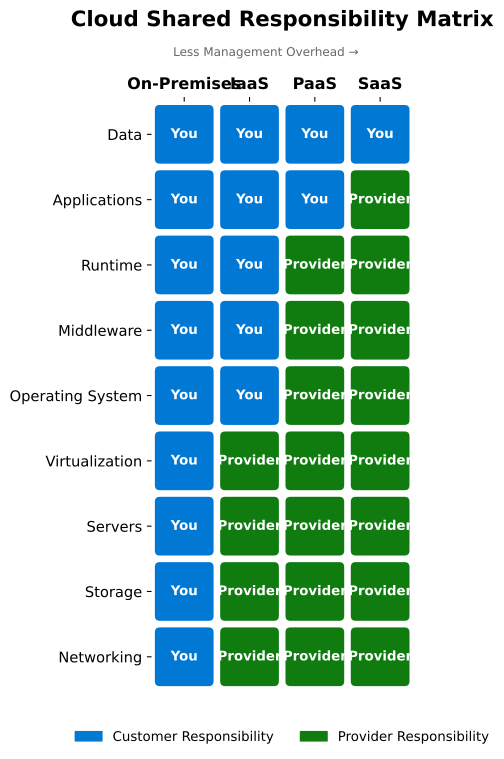 Figure 1: Shared Responsibility Matrix across cloud service models
Shared Responsibility Model (Table)
| Layer | On-Premises | IaaS | PaaS | SaaS |
|---|---|---|---|---|
| Data | 🔵 You | 🔵 You | 🔵 You | 🔵 You |
| Applications | 🔵 You | 🔵 You | 🔵 You | 🟢 Provider |
| Runtime | 🔵 You | 🔵 You | 🟢 Provider | 🟢 Provider |
| Middleware | 🔵 You | 🔵 You | 🟢 Provider | 🟢 Provider |
| Operating System | 🔵 You | 🔵 You | 🟢 Provider | 🟢 Provider |
| Virtualization | 🔵 You | 🟢 Provider | 🟢 Provider | 🟢 Provider |
| Servers | 🔵 You | 🟢 Provider | 🟢 Provider | 🟢 Provider |
| Storage | 🔵 You | 🟢 Provider | 🟢 Provider | 🟢 Provider |
| Networking | 🔵 You | 🟢 Provider | 🟢 Provider | 🟢 Provider |
🔵 You = Customer Responsibility | 🟢 Provider = Cloud Provider Responsibility
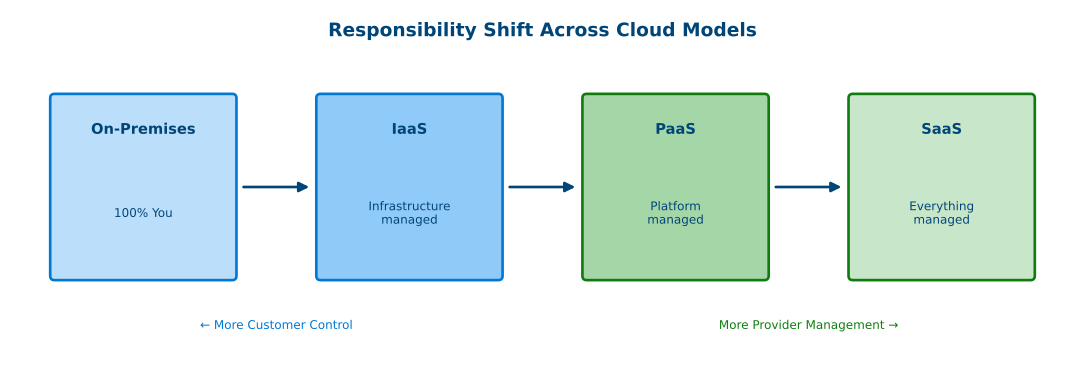 Figure: Responsibility shifts from customer to provider as you move from On-Premises to SaaS
IaaS Responsibilities
Section titled “IaaS Responsibilities”Customer Responsible For:
- Operating system updates and patches
- Application security
- Network configuration
- Access management
- Data encryption
- Backup and recovery
Provider Responsible For:
- Physical security
- Hardware maintenance
- Network infrastructure
- Hypervisor security
- Power and cooling
PaaS Responsibilities
Section titled “PaaS Responsibilities”Customer Responsible For:
- Application code security
- Data protection
- User access management
- Application configuration
- Identity management
Provider Responsible For:
- Operating system maintenance
- Runtime environment security
- Platform scaling
- Infrastructure security
- Network security
SaaS Responsibilities
Section titled “SaaS Responsibilities”Customer Responsible For:
- Data classification
- User access management
- Device management
- Account management
Provider Responsible For:
- Application security
- Infrastructure security
- Platform maintenance
- Data backup
- Network security
Choosing the Right Service Model
Section titled “Choosing the Right Service Model”Choose IaaS: Maximum control, specific configurations, specialized requirements, lift-and-shift migrations Choose PaaS: Focus on development, rapid deployment, cloud-native apps, managed services Choose SaaS: Immediate application access, limited IT resources, subscription pricing, collaboration needs
Cost Comparison
Section titled “Cost Comparison”IaaS: Lower base costs but higher management overhead PaaS: Higher base costs but lower management overhead SaaS: Per-user pricing, no management overhead
Hybrid and Multi-Service Approaches
Section titled “Hybrid and Multi-Service Approaches”Combining Service Models
Section titled “Combining Service Models”Many organizations use multiple service models simultaneously:
Example Architecture:
- SaaS: Microsoft 365 for productivity and collaboration
- PaaS: Azure App Service for custom web applications
- IaaS: Virtual machines for legacy applications
Benefits:
- Optimize each workload for appropriate service model
- Gradual cloud migration strategy
- Balance control and convenience
Real-World Example
Section titled “Real-World Example”Organizations often combine all three models: SaaS: Microsoft 365 for collaboration PaaS: Azure App Service for custom apps IaaS: VMs for legacy applications
Cloud Migration Journey
Section titled “Cloud Migration Journey”Phase 1 (IaaS): Lift-and-shift existing applications Phase 2 (PaaS): Modernize with cloud-native services Phase 3 (SaaS + PaaS): Adopt SaaS where possible, build differentiators on PaaS
Common Pitfalls & Best Practices
Section titled “Common Pitfalls & Best Practices”IaaS: Avoid under-estimating management; use infrastructure as code, monitoring, auto-scaling PaaS: Plan for portability; implement logging, API-first design, understand service limits SaaS: Establish data governance; invest in training, plan integrations early
Summary
Section titled “Summary”Understanding cloud service models is fundamental to making informed decisions about cloud adoption:
- IaaS provides maximum control and flexibility with higher management overhead
- PaaS balances control and convenience, enabling rapid application development
- SaaS offers immediate value with minimal management requirements
Most organizations benefit from a multi-model approach, selecting the appropriate service model for each workload based on requirements, constraints, and strategic objectives.
Next Steps
Section titled “Next Steps”- ✅ Review service model characteristics and use cases
- ✅ Consider which models apply to your organization’s needs
- ✅ Continue to Cloud Deployment Models
- ✅ Complete the Knowledge Check
Additional Resources
Section titled “Additional Resources”Last Updated: November 2025